All
backpacking books, women's adventure books and Camino de
Santiago books
from the website summarized on one page
for your convenience.
We've also added a general link to Amazon, and a display of
their top hiking selling hiking books, so if you want
anything from Amazon, you can support this site by doing your
Amazon purchases through either of these links.
This is a long page so you can click on the
book categories below, to get there faster.
Authors, Publishers, if you have a new book that you think is
appropriate for this list, please send an email with more
info, asking if we want a review copy. If we ask for it, we
won't guarantee to include it in the recommended list, but
promise to read it and give it honest consideration.
If you want to support our website, use this
link whenever you want to get anything from Amazon.
<========<
To Go Directly to Amazon
Home Page
Amazon's
Hiking Best Selling Items;
Classic Backpacking Books
The core issues of backpacking are shelter, food and health.
The long distance hikers have by far the most experience.
Their trips may seem extreme, but what they have to say is also
valid for the weekend backpack of a few miles in and out.
out of print
Colin Fletcher walked through California
from the Mexican border to the Oregon border in 1958 and
wrote The Thousand Mile
Summer. He continued writing the
following:
The
Man Who Walked Thru Time
out of print
The Winds of Mara - all
good reads, but mostly story telling.
He then came out with The
Complete Walker, with several versions
up to the latest one: The
Complete Walker IV (co authored by Chip
Rawlins). This newest book is not as much fun
to read, but a good reference, called by some "The
Hiker's Bible."
out of print
Ray and Jenny Jardine have
walked over 15,000 miles including the Pacific Crest
Trail from Mexico to Canada three times, the Appalachian
Trail and the Continental Divide Trail. As they refined
their techniques during these trips, Ray became
convinced of the importance of lowering the total weight
carried. He has written two books, based on their
experiences. The first one is
The Pacific Crest Trail Hiker's
Handbook, focused on what is needed to
complete the PCT, but also emphasizing universal
approaches for successful backpacking, including
ultralight gear.
The second one is
Beyond Backpacking - Ray
Jardine's Guide to Lightweight Hiking,
expanding the ideas in the first book.
If you are going to do the PCT, or other long
distance hiking, you must read
the Beyond Backpacking - above.
Fixing Your Feet
by John Vonhof. There are many ideas on preventing blisters & caring for your
feet, and they are all here. Not just for backpackers, but certainly a
one of a kind book that needs to be mentioned. His new edition will be out in June, and you can preorder it from Amazon:
Karen Berger is one of the select few who
have hiked the Triple Crown - Pacific Crest Trail, Appalachian Trail and
Continental Divide Trail. Also a talented and prolific author, read her
Hiking the Triple Crown to get an excellent overview of these three
trails, and what is involved in doing any or all of them.
Our Book - A Soon to be Classic for
Mid-Aged Backpackers
Susan Alcorn has been backpacking
many years in the Sierra Nevada, including completion of the
John Muir Trail in segments. She also walked the Spanish
segment of the Camino de Santiago
- a 450 pilgrimage trail across northern
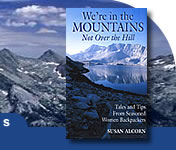
Spain. We're
in the Mountains, Not Over the Hill,
Tales and Tips From Seasoned Women
Backpackers is based on her own experiences and her
interviews of three dozen women in their 40s to 70s who
are still backpacking. This is a distillation of both
stories and how to information – the why do it, the fears, the
keys to success, based on the experiences of these "seasoned"
women, and a good guide for anyone who has thought about
backpacking, more than something for your women's adventure
books reading list.
Any Pacific Crest Trail guide will include at least a section
on the JMT, as it is the longest part of the PCT with no intersecting road
access, but for backpacking books with more detail, look at:
The original guide is
Starr's Guide to the John Muir Trail and the High
Sierra Region, written by Walter Starr Jr. in 1933
and published by the Sierra Club. It is still available
in revised form. Nicknamed Peter, the author vanished
during a trip to the Minarets in 1933, his body was
found after an intense search, and his book was
published posthumously. See Missing in the Minarets
further down this list for a good story.
Blackwoods Press is
came out with John Muir Trail Atlas in spring 2010.
This is a small pocket guide with maps, water sources,
miles, etc. I have used their PCT Atlas and found it an
adequate though bare minimum guidebook. If weight is
important check out
http://www.johnmuirtrailatlas.com
The Wilderness Press
publishes a number of excellent guides to this region
including, Elizabeth Wenk and Kathy Morey's Guide
to the John Muir Trail, photos, maps and route descriptions.
4th edition just out in 2007 now includes GPS waypoints.
Wilderness Press has allowed the waypoint - campsite
list to be downloadable - link in our gps section.
Their
series for shorter trips is based on the USGS map
quadrangles and is pocket size. Each book includes the
map and the descriptions of routes within that map.
They also put out
Sierra South which covers the John Muir Trail area,
by Kathy Morey and Mike White, The 8th edition is an
excellent guide, organized by access highways, and
includes route elevation profiles
as well as Sierra
Northby Kathy Morey & Mike White,which covers the Sierra from Yosemite north.
Both of these are a good addition to your hiking
bookshelf.
Mount Whitney: Mountain Lore From The
Whitney Store by Thompson and Newbold. This is the
definitive reference for anyone climbing Whitney,
particularly from the east side. If you are going
to climb Whitney, read this book. It could save
your life.
The Geology of the
John Muir Trail by James
Wise. I haven't had a chance to read this, but it
definitely fills a void.
A Hike for Mike by Jeff Alt. This journal of a couple's John Muir Trail walk is also a plea for depression awareness. Good armchair reading.
See
www.hikeformike.com for more about their campaign
and hike.
The Last Season by Eric Blehm -
This non-fiction mystery on the disappearance of a
back-country ranger in Sequoia-Kings Canyon NP gives an
insight into the daily lives of those with the unique
experience of living and working in a National Park.
Missing in the
Minarets - The Search for Walter A. Starr, Jr.
by William Alsup. This is the story of the disappearance
and search for Peter Starr, author of Starr's Guide
above. Good reading and a good mystery, it gives a
glimpse into a different era in the Sierras.
Deep Survival: Who Lives, Who Dies and Why by Laurence Gonzales.
This should be mandatory reading for anyone doing moderate
risk activities, let alone thru-hikers, backpackers,
mountain climbers, etc. It certainly made me rethink the
things we do when backpacking. It makes fascinating
reading, but to summarize what I got out of it: Be sure
that what you are thinking of as many years of
experience, is not really many years of being very
lucky.
Ray Jardine's Trail
Life is a must for anyone thinking about doing the PCT
and a good idea for the JMT.
The 3rd version of his classic lightweight backpacking book. The origin of the ultralight
philosophy - updates Beyond Backpacking
Sierra Crest Route by
Leonard Daughenbaugh. You know of the JMT, and probably
Steve Roper's High Route. This book describes a route
closer yet to the Sierra Crest, entirely off trail, no
more than a mile off the crest, and usually within a
half mile of the crest. Almost all text, most in
description of mountaineering opportunities from the
route, so I expect that this will become a mountaineer's
bible.
And a DVD
Bob Kenan was a backcountry ranger in
Sequoia-Kings Canyon National Park for 30 years. He has
put together a DVD of his experiences, including
interviews with other backcountry rangers, and some 50
interviews with backpackers and PCT thru-hikers. I
haven't seen it, but sounds good. Order from his site at
http://www.messagefromthemountains.net
Laws Field Guide to the Sierra
Nevada by John Muir Laws was published this year
by one of my favorite publishers, Heydey Books in
Berkeley, CA, in conjunction with the Cal Academy of
Science.
Sierra Birds: A Hikers Guide also by John Muir Laws, and praised by Amazon
reviewers, though I have not seen it.
Sierra Nevada Wildflowers
by Elizabeth Horn. Descriptions and color photos of many
of the wild flowers you will see on the JMT.
Fixing Your Feet
- Jon Vonhof is the last word on foot care. He treats
feet on ultra marathons and will give you more than you
ever wanted to know on treating blisters and foot
problems.
Unseen Hazards That Threaten
Hunters, Campers and Hikers - Jerry Genesio.
i.e. bacteria that can kill you while hiking in US.
Haven't read it, but plan to.
Gifts from the Mountain, Simple
Truths for Life's Complexities by Eileen
McDargh. Watercolors and wisdom drawn from
backpacking inspiration. Not just JMT. Hard to classify, but I highly
recommend it.
Classic Hikes of the World by Peter Potterfield - . A gorgeous book full of
tempting hikes if the JMT experience has infected you.
One of the featured hikes is the JMT.
Off topic, but if you fish the JMT,
check this out: Field Guide to Freshwater Fishes of
California by Samuel McGinnis, illustrated by Doris
Alcorn - my ex. The illustrations are world class - a
life's work.
Last Child in the Woods: Saving
Our Children from Nature-Deficit Disorder by
Richard Louv. Not on JMT, but a strong case for getting
children out into the wilderness.
Classic Pacific Crest Trail Books
Classic Books for the PCT:
Ray Jardine's Trail
Life is a must for anyone thinking about doing the PCT.
The 3rd version of his classic lightweight backpacking book. The origin of the ultralight
philosophy - updates Beyond Backpacking
Ray Jardine's Beyond Backpacking
- the 2nd version of his classic lightweight backpacking book,
and has the essentials, even though Trail Life has additional
information.
Ben Go's Pacific Crest Trail Data Book- distances, features, water sources, facilities on the PCT,
elevation profiles and resupply stations - Ben is Benedict for author
lookup purposes.This book is intended to be used with the two
below. A must. Use the current edition.
.
Jeff Schaffer, Thomas Winnett and others:
The Pacific Crest Trail:
Southern California A must read, cut out appropriate
sections, carry 1st one and rest go in the resupply boxes. A
must.
Jeff Schaffer: The Pacific Crest Trail:
Northern California A must read, cut out appropriate
sections, carry 1st one and rest go in the resupply boxes. - this is a new book - March
2003. A must.
Jeff Schaffer, Andy Selters
The Pacific Crest Trail: Oregon & Washington New
edition as of 2004 - A must for the PCT hiker.
Yogi's PCT Handbook.
She has hiked the PCT at least 3 times and has put together a
very good 2 part handbook, the large pages
to be read ahead of time and small pages to be carried with
you. Further detail on water points, resupply, etc. You have
to order it from her - see her website
www.pcthandbook.com
Highly recommended.
Eric the Black's 5 volume PCT Trail Atlas. This is a pocket
sized guide with color maps, utm coordinates, camping and
water locations. I have used it and prefer the greater detail
of the Wilderness Press guides, along with my own maps, but it
is a useful choice. Eric has also done a JMT Atlas.
Leslie Croot's Pacific Crest Trail Town
GuideThe guide to the 80+ towns and resupply points along the PCT
- getting somewhat dated.
George and Patricia Semb Day Hikes on the Pacific Crest
Trail: California - Good for planning resupply points -
lists access points to PCT.
George and Patricia Semb Day Hikes on the Pacific Crest
Trail: Oregon & Washington - Good for planning resupply
points - lists access points to PCT.
Relevant to PCT Hikers, but not
guidebooks
Laurence Gonzales's Deep Survival: Who Lives, Who Dies
and Why. This should be mandatory reading for anyone
doing moderate risk activities, let alone thru-hikers,
backpackers, mountain climbers, etc. It certainly made me
rethink the things we do when backpacking. It makes
fascinating reading, but to summarize what I got out of it: Be
sure that what you are thinking of as many years of
experience, is not really many years of being very lucky.
Aaron Doss Sierra
Nevada The Range of Light Aaron is a 2006 pct hiker
that we crossed paths with for several days. He was constantly
taking photos, and now has come out with this absolutely
spectacular tabletop photo book. Its pricey and hard to get,
but worth it.
Karen Burger and Daniel Smith's
The Pacific Crest Trail: A Hiker's
Companion- route descriptions, day hikes, short backpacks, plant & animal
info, history. Don't know that I would carry this - maybe read first
and cut out what I wanted.
Jon Vonhof Fixing Your
Feet is the last word on foot care. He treats feet on
ultra marathons and will give you more than you ever wanted to
know on treating blisters and foot problems.
Elizabeth Horn - Sierra Nevada
Wildflowers . Descriptions and color
photos of many of the wild flowers you will see in the
Sierras.
Leonard Daughenbaugh - Sierra Crest Route. You know of the JMT, and probably Steve Roper's
High Route. This book describes a route closer yet to the
Sierra Crest, entirely off trail, no more than a mile off the
crest, and usually within a half mile of the crest. Almost all
text, most in description of mountaineering opportunities from
the route, so I expect that this will become a mountaineer's
bible.
Personal Accounts
Cheryl Strayed -
Wild: From Lost to Found on the Pacific Crest Trail. I A very popular personal account - good story of Cheryl's life experience. Quite a bit more in it than just the pct experience.
"No Way" Ray Echols - A Thru-Hiker's Heart - Tales of the Pacific Crest Trail.
I love reading PCT accounts, and this is no exception, but there are
very few that I would recommend to my non-hiking friends. This is
one of those. It is more like reading Edward Abbey than a hiker's
story.
Barbara Egbert - Zero Days: The Real-Life Adventure of
Captain Bligh, Nellie Bly and 10-year- old Scrambler on the
Pacific Crest Trail - We met Scrambler and her family
at the kickoff, and enjoyed reading this tale
of her adventure by her journalist mother.
Since Matt's talk, Angela &
Duffy Ballard wrote A Blistered Kind of Love. This an
entertaining adventure read, not a how to, though it gives you
a good feel for what is needed. Read it before you go,
particularly if you are a couple.
Dan White -
The Cactus Eaters, How I Lost My Mind - And Almost Found
Myself - On The Pacific Crest Trail. This lighthearted
account, got a lot more prestigious reviews than anything else
I've seen on the PCT, and I was a little biased against it,
thinking the book professionals were attempting to anoint a
new Bill Bryson. I did enjoy it in spite of my attitude. It's
a little a la Bryson, but that's a good thing. I
actually like Bill Bryson. Also, Dan's walk was a few years
back, so I found it interesting comparing the differences over
just a few years
Diane Soini - Piper's Flight: A solo woman's journal on the Pacific Crest Trail. I haven't read Piper's account, but she is a respected member of the trail community and I am sure what she has to say is of value.
Diane Soini - Adventure and Magic. This is Diane's ebook of her journal on the PCT. Available from Lulu.
Another one Matt
Geis mentioned is Soul Sweat & Survival on the Pacific
Crest Trailby Bob Holtel. This is someone who did a solo run
over the PCT in the course of three summers.
Eleanor Guilford - One
Hundred Mile Summers: Hiking the Pacific Coast Trail from
Mexico to Canada Eleanor is the oldest woman I know to
have completed the pct (in 1989 at age of 71). Now (2008) at
age of 91 she is giving REI talks on the pct. When Eleanor did
the PCT, there were fewer thru-hikers, and a lot more
temporary sections. Just reading about trail conditions 18
years ago, will keep your attention.
George Spearing: Dances
With Marmots, A Pacific Crest Trail Adventure -
available in paperback or download. A lot of people have
enjoyed this. Check out all the reviews in Amazon.
Pacific Coast Trailway
was compiled by Clinton C Clark in 1945. This classic was
recently scanned by Daniel Craig Giffen and is available for
online viewing at
pcttrailway.pctplanner.com
Go here to see all the Amazon
Pacific Crest Trail Books
Not directly PCT Related but of
interest to PCT Hikers
Elias Butler and Tom Myers -
Grand Obsession, Harvey Butchart and the Exploration of
Grand Canyon. Butchart was the first person to
thoroughly explore the Grand Canyon on foot, and the first
person to walk the length of the park below the rim. His tips
were what enabled Colin Fletcher to walk it in one season.
Also a story of hiking obsession, a story known to all long
distance hikers. In Nov 2008, this book won a National Outdoor
Book Award in the History/Biography category.
Colin
Fletcher - The Man Who Walked Through Time. The classic story
of Fletcher's walk through the Grand Canyon.
Lawton "Disco" Grinter - I Hike an entertaining collection of trail stories, mostly true by this Triple Crown hiker. Think Bill Bryson.
Unseen Hazards That Threaten
Hunters, Campers and Hikers - Jerry Genesio.
i.e. bacteria that can kill you while hiking in US.
Haven't read it, but plan to.
Gifts from the
Mountain, Simple Truths for Life's Complexities by
Eileen McDargh. Watercolors and wisdom drawn from
backpacking inspiration. Not just PCT. Hard to classify, but I highly
recommend it.
Peter Potterfield - Classic Hikes of the
World. A gorgeous book full of tempting hikes if the
PCT experience has infected you. Does not include the PCT but
has the JMT.
Last Child in the Woods: Saving Our
Children from Nature-Deficit Disorder by Richard Louv.
Not on JMT, but a strong case for getting children out into
the wilderness.
Spark Your Dream
by Candelaria & Herman Zapp. Not a PCT hiker story, or
even a walker's story, but an incredible long distance
adventure. Cande is from Argentina. They drove their 1928
Graham-Paige sedan from Argentina to Prudhoe Bay, Alaska, having a child in
the process. We met this couple and their car while they were
selling their book outside of a local harvest festival in
2008. Still a young couple, they now have three children, are
expecting their fourth, and are planning to drive their car
across Asia.
Three Hundred Zeroes by
Dennis Blanchard. For those PCTers who are considering the
Appalachian Trail, this personal account gives you a good feel
for what to expect.
There are two well known ones that need to be
mentioned, even though they both are a mixture of trail experiences
common to all pilgrims, and some other experiences that include
visits with spirits of pilgrims past. They both make interesting
related reading, but for those new to the Camino, be aware that
these are in no way practical guides.
For the day by day walking, you must take the Confraternity of St.
James guide in the following list. I recommend that you also take
the Davies and Cole guide (or the John Brierley Camino Francés
guide) and the 35 pages from the Lonely Planet Walking Guide. If you
want to understand the historical significance of the areas you walk
through. I suggest that you buy Gitlitz and Davidson before you go,
and take some parts of it with you.
Walker's/Cyclist's Guides
Camino Francés to Finisterre
The Lonely
Planet Walking Guide to Spain has a good section on the
Camino - rip out all but the Camino pages. Note: for our
2001 walk we used the 2nd edition, published in July 99.
Nancy Frey and Jose Placer did the Camino part. A 3rd
edition is now out with the same authors - as far as I can see,
mostly cosmetic changes, maps are a little easier to read,
mileages changed slightly, now takes 30 days instead of 28.
There is a summary list of all the refugios at the beginning.
The refugio info will get more and more out of date as we move
beyond 2003. The Camino section authors have a well regarded
walking tours company
www.onfootinspain.com
that offers Camino tours of various lengths.
publishes
Pilgrim Guides To Spain 1. The Camino Francés - a small purple book (was yellow) that is your
indispensable guide to the next refugio. A must have. There
is a new one issued for each year. Get the current one if you
can, as refugios are added and closed from year to year. This by the way,
will have to be ordered from England. We got ours
from the website www.csj.org.uk
. If you don't get it in a week, call to make sure they got your
web order. Also, for bicyclists in their Practical
Pilgrim Notes section you can find The Cycling Pilgrim on the
Camino Francés.
Davies and
Cole - Walking the Camino de Santiago is an excellent
guide that first came out in 2003. It weighs 7 oz., describes the route,
some of the history, plus some of the flora and fauna. It reads
easily, has some sketch maps and elevation profiles of the
route. The current 2009
edition is about half the weight of the original, and the maps
are even better. If you want to give the authors a little more
money, go to their website
www.pilipalapress.com
John
Brierley - A Pilgrim's Guide to the Camino Francés:
From St. Jean Pied de Port to Santiago de Compostela. This
2010 6th edition is full color with excellent maps and trail
profiles along with route descriptions. Each map represents a
typical day. Good beginner info, self help info for the
spiritual journey. This is my personal favorite, but Davies and
Cole works as well. We cut out appropriate
sections from Davies and Cole and this guide on a recent
trip, as well as carried the confraternity guide. In practice we
mostly used the Brierley guide because of the color maps, and
its accommodations were even more accurate than the comparable
confraternity guide. For recent updates to the guide, check
http://www.caminoguides.com/latest.html
Alison Raju wrote
The Way of St James Le Puy to Santiago A Walkers Guide.
This 2001 guide starts at Le Puy en Velay in France and gives detailed
route info all the way to Santiago, including some photos and
maps. Weighs about a pound. The author updated this and broke it into two books.
Alison Raju - The Way of St. James: Pyrenees - Santiago - Finisterre. We don't have this 2004 guide, but assume it is similar to the Le Puy to the Pyrenees guide. Good, but for this section I still recommend either Davies and Cole or John Brierley.
John
Brierley - A Pilgrim's Guide to the Camino Fisterra.
The same format of fine maps, photos and route descriptions as
in his Camino Francés guide if you want to go on to Finisterre.
For recent updates check
http://www.caminoguides.com/latest.html
Milan Bravo Lozano - A Practical Guide for Pilgrims:
The Road to Santiago - This heavy 1999 guide is published in
Spain in Spanish and English and includes a popular set of maps.
Some people leave the book and take the maps. I saw a copy
recently - large, stiff pages, I didn't measure, but would guess
6 in wide, 11 in tall - must have weighed a couple of pounds.
Jaffa Raza - The Village to Village Guide to The Camino Santiago. I haven't had a chance to read this yet - the 2006 2nd edition, in paperback. It is a detailed guidebook, highly recommended by the Catholic Times, and currently the most expensive guidebook at about $37.
Cordula Rabe - Camino
De Santiago: From the Pyrenees to Santiago De Compestela (Rother
Walking Guide). Justin and Aleza, who's
Circumvent the Globe blog I am following, are using this and
like it. It is small 6.5 by 4.5 by .5 in., in color, somewhat
weather resistant, and packed with maps, route descriptions,
history, and fairly tiny type. Weighs about 8 ounces.
Davies and Cole -
Camino de Santiago Map. This little 4 x 8.5 in booklet
weighs 3 ounces, and is an excellent choice if you want the
comfort of maps with more amount of detail than the simple
sketch maps in the guidebooks. It breaks the route from St. Jean
to Santiago & Finisterre into 40 maps, and includes maps for the
6 cathedral cities along the route.
Waterproof Camino Francés map, 30 pages, refugio and
other info on back of each page. 5x10 inches. A useful addition to
maps available.
John Brierley -
Camino de Santiago Maps/ Mapas/ Cartes I haven't seen this,
but I have used his guides, which include very useful maps, and
this appears to be those maps and town guides extracted into a
separate publication.
John Higginson - The
Way Of St James: A Cyclist's Guide : from Le Puy en Velay to
Santiago de Compostela. This little pocket sized Cicerone
Guide looks useful, with daily stages listed. For each day, a
simple line map, an elevation profile, photos and town
descriptions. For accommodations, I suggest also carrying the
Miam Miam Dodo for the French part, and Confraternity of St.
James guide for the Spanish part. My version is 1999, but the
one in Amazon is 2005.
The Galician government has
built an excellent website, with info on the various routes,
including a
pdf for bicycling the French Way.
Hape Kerkeling - I'm
Off Then: Losing and Finding Myself on the Camino de Santiago.
This German best seller pilgrim narrative was just recently
translated into English. Hape Kerleling is a well known German
humorist.
Raimund Joos and Michael Kasper-
Spanien: Jakobsweg Camino Francés: Der Weg ist das Ziel (Broschiert).
A guidebook in German to the Camino Francés. You can browse it
with Amazon's Search Inside the Book..
Downloadable Guides:
www.caminoguide.net has
free guides for via de la plata and camino aragones, and both a
basic free guide and a for
fee downloadable guide to the Camino Francés.
Le Puy Route and France Guides
Alison Raju - The Way of St. James (Chemin de Saint-Jacques de Compostelle): Le Puy to the Pyrenees - We just used this excellent 2004 guide - the most detailed English language guide available for this section. Weighs 8 oz. Also take the GR 65 topo-guides and Miam Miam Dodo guides
- in French but still useful if you don't read French.
Miam Miam Dodo guides - they are in French but essential even if you
don't read French. You can get the Miam Miam Dodo from Amazon
France. Be sure to get the current one, they frequently have
older ones as well. I ordered mine from Amazon France using
Google Translate to translate each page, since I don't speak or
read French. Also, be sure you get one for the correct route.
There is one for the Arles route as well as the Le Puy route and
the Camino Francés.Their website (in French):
www.chemindecompostelle.com
.
Alison Raju wrote
The Way of St James Le Puy to Santiago A Walkers Guide.
This 2001 guide starts at Le Puy en Velay in France and gives detailed
route info all the way to Santiago, including some photos and
maps. Weighs about a pound. The author updated this and broke it into two books.
Birgit Götzmann
- Frankreich: Jakobsweg
Via gebennensis - Via podiensis: Via Gebennensis - via Podiensis (Broschiert)
- a guide in German to the Le Puy route. You can browse it with
Amazon's Search Inside the Book.
Confraternity of Saint JamesPilgrim Guides to the Roads
through France -Arles to Puente la Reina - Arles to Toulouse
2007, Marigold Fox - isbn 9781870585989
Confraternity of Saint JamesPilgrim Guides to the Roads
through France - Arles to Puente la Reina - Toulouse to
Puente la Reina 2007, Marigold Fox - isbn 9781870585992
Mireille
Retail, Marie-Virginie CambrielsMiam-miam-dodo du chemin d'Arles +
le camino aragonés : Chemin de Compostelle (GR 653) d'Arles au
col du Somport, du Somport à Puente la Reina, - isbn 9782916446127
We ordered this from Amazon France.
Louis Laborde-Balen -
Jean-Pierre Siréjol - Le chemin d'Arles vers
Saint-Jacques-de-Compostelle, - isbn 9782841823475. We
ordered this from Amazon France. It is listed in us and uk, but
not available.
Francois Lepere & André
DehnelSur le chemin de Saint-Jacques-de-Compostelle, la via
Tolosona, la voie du soleil... - isbn 9782915156003 We bought this from a CH en route. It doesn't
have a printing date, and Amazon France lists the same isbn
saying it is 2003 edition, and has no image. The site in the
link is the only one with the correct image, but don't know if
you can order from them. We used very little.
Les Chemins De Saint Jacques De Compostelle En
Europe - a map showing all the routes to Santiago de Compostella
through Europe. In French, for before or after trip, not something
you take with you.
.
Florence Chatzigianis
wrote 26 Gorgeous Hikes on the Western Côte d'Azur. This
is an area very near the start of the Arles route, so if you are
planning to spend additional time in the area, you may find this
book useful.
John Brierley - A
Pilgrim's Guide to the Camino Portugués. In the same style
as his other guides, this is an excellent guide for the Portugal
route from Porto Santiago de Compostella. Also check for recent
updates at
http://www.caminoguides.com/latest.html
Davies and Cole - Walking in Portugal
I haven't seen this book either, but I assume it is in the
same style as their excellent book on Walking the Camino de
Santiago mentioned earlier. It was published in 2000, so be
sure to check the authors' update page for current updates:
http://www.pilipalapress.com/portugal/updates.html
Davies and Cole - Walking the Via de la
Plata: The Camino de Santiago from Sevilla to Santiago de
Compostela. I haven't seen this book, but based on Amazon
reviews, it is in the same style as their excellent book on
Walking the Camino de Santiago mentioned earlier. It was
published in 2004, so also check the authors' update page for
current updates:
http://www.pilipalapress.com/plata/updates.html
Alison Raju - Via de la Plata: The Way
of St James: Seville/Granada to Santiago. Published in 2010. This route is
about 1000km, typically starting in Seville. This guide includes
the Camino Mozárabe from Granada to Mérida. We used it on our
walk from Granada to Córdoba. It is in the same style as her
other guides, terse, pocket size, very helpful, with a dose of
history. She also did a 2009 Confraternity of St. James guide
for the Camino Mozárabe that contains almost the identical
information included here.
Marcus Wilder - Naïve & Abroad: Spain,
Limping 600 Miles Through History. I've only read a few
excepts from Marcus's newspaper accounts, but enjoyed them. This
is the only pilgrim account I have heard of for the Via de la
Plata.
Camino Norte, Primitivo, Inglés, Finisterre and Camino
Portugués Guides
Laura Perazzoli and Dave Whitson - The Northern Caminos. Norte, Primitivo and Inglés An excellent guide from the Cicerone Guide series. In color. My only reservation is that it is heavy 3/4 pound for this 4 1/2 by 6 3/4 inch guide. Possibly will be available in Kindle later. In pre release for amazon.com until April 2013.
The Confraternity of St. James guides are
available online. You can download any of these guides as a word
file, which you can edit, or a pdf file which cannot be edited.
A donation is expected. See:
http://www.csj.org.uk/guides-online.htm
History and Academic Accounts
Derry Brabbs'sThe
Roads To Santiago, The medieval pilgrim routes through France
and Spain to Santiago de Compostela. This is a gorgeous
coffee table book, in color, with many striking images
from the pilgrimage paths. It is much more than a book of
beautiful photos. This work is a Tour de Force. Imagine Gitlitz
& Davidson (below), but with color photos and including the four
major routes through France. The text alone is worthy of publication, just
as a description of the history of the route.
Gitlitz and
Davidson's The Pilgrimage Road to Santiago has more than
most people want to know about everything along the path. It
also weighs almost one and a half pounds. We edited it with
scissors and cut the weight by half, and discarded pages after
we went thru a section. When we got home, we bought a new copy.
William Bonville - A
Traveler's Highway to Heaven: Exploring the History & Culture of
Northern Spain on El Camino de Santiago - I haven't read
this yet, but has been mentioned on Yahoo groups as a competitor
to Gitlitz and Davidson. Others have pointed out its many
inaccuracies re current pilgrimage customs, but it may be better
on historical detail.
Edwin Mullins - The
Pilgrimage to Santiago. Architecture and history with
authority. This reissue of the 1974 classic follows architecture
on the pilgrim path from Paris to Santiago. Part of the time by car,
part on foot, he follows the Christian architecture from church
to church, carving to carving, as the techniques move south.
Slow reading, but he captures your interest. Worth reading both
before and after your pilgrimage.
William Melczer - The Pilgrim's Guide The
first English translation of the original 12th century guidebook
to the Camino. This 345 page book is heavily documented with
notes, introduction, thumbnail descriptions of saints and
place names. The actual Codex Book 5 translation is 50 pages.
Excellent after Camino read for history, or a before read if you
have a good memory for facts.
Louise Collis - Memoirs of a Medieval Woman. Margery Kempe was a woman of the middle ages who aspired to sainthood. As part of this, she went on pilgrimage to Jerusalem, to Rome and to Santiago de Compostella. She could neither read nor write, but got others to write her story for her. There is very little about the trip to Santiago; it was practically a trivial trip compared to the others, but it is a fascinating glimpse into the experience of being on pilgrimage in those times.
Walter Starkie - The Road to Santiago:
Pilgrims of St. James. Published in 1957, is a combination
guide, history and personal account of his Camino de Santiago
pilgrimages. Dr. Starkie made 4 pilgrimages to Santiago between
1924 and 1954, and from what I gathered from the book, lived in
Spain for a number of years. This is a classic reference used as the Camino
began to revive in the 1970s and 80s. Out of print and now very
expensive. It was also reprinted in 2003.
Nancy Frey - Pilgrim Stories.The
author walked the Camino, worked in the refugios, and
interviewed many pilgrims about their experience. It gives a
good feel for the nature of the experience.
Nancy Frey and Jose Placer have a well regarded
walking tours company
www.onfootinspain.com that offers Camino tours of various
lengths.
James Michener - Iberia: Spanish Travels and
Reflections A personal favorite that I have read several
times. Easier reading than Cees Nooteboom, but a similar love of
Spain. The last chapter is about the pilgrimage to Santiago, and
worth reading even though he drove. Written during the Franco
era and sheds light on that time.
Kathy Gower - Her doctoral dissertation
on how pilgrims incorporate their pilgrim experience into their
daily lives is good reading. You can find it in the Yahoo Group Santiagobis files section.
Joan Myers, Simmons & Pierce - Santiago
- Saint of Two Worlds - 1991 A beautiful black and white
photo essay, almost letter size. Joan Myers did all the photos
and some of the included essays. I am still reading this, and
enjoying the essays. It was published by the University of New
Mexico Press, and is unique in that it covers the influence of
St. James in Mexico, and in New Mexico.
James Stone - The Cult of Santiago -
Traditions, Myths and Pilgrimages. Published in 1927. This is an
early source that has been scanned and is available online. I
haven't read all of it, but the author has an engaging style of
writing, and I enjoyed the introduction, and the Sources of
Authority chapters, where you will find deft and gentle
criticism of earlier authors.
Kingsley Porter - Romanesque sculpture
of the pilgrimage roads (1923). This is another classic text
referred to by later authors. This is a 3 volume work, and at
least the first volume has been scanned and available online. It
has also been reprinted, 1966, 1985 and you can find a few
copies on Amazon.
V1
Georgiana Goddard King - The Way of St.
James. Published in 1920, This three volume set has recently
been scanned by the University of Toronto. and you can view it
in various ways in:
http://www.archive.org/details/wayofsaintjames01kinguoft .
Change the 01 to 02 & 03 for subsequent volumes. I recommend the
Flip Book choice for viewing it. Do take the time to view some
of this book, particularly after you have completed some of the
Camino. Some text samples:
"Possibly it will be said that this little book is neither one
thing nor the other as it offers archaeology without jargon,
travel without flippancy... The original intention of this book
was to examine the claims for the sources of Spanish
architecture in the Gothic and Romanesque period." Sounds dry,
but she strayed from her intentions and her descriptions of her
travels captivated me. On page 260 she is in Pamplona, talking
about the nightly promenade: "For an hour and a half every
evening the nobility of Navarre walked in beauty there, in
rustling and murmuring of silk, and voices, and dark leafage;
warm puffs of perfume through a night wind blowing out of dark
and mountains..." - not your usual travel narrative.
This three volume set has been reprinted by Pilgrims Progress
and is available on Amazon.
William Caxton - The Golden Legend
published in 1483 is a translation of an earlier French work
published in 1275. This is a history of the Saints, and the
chapter on St. James is the source of information for many later
accounts. For example, the account of where he preached, how his
body got to Spain, the miracles preformed etc. The St. James
chapter has been scanned and is available online. It makes
interesting reading if you like nitty gritty.
Relevant Background on Spain, but
not just Camino
Maria Rosa Menocal - The Ornament of
the World: How Muslims, Jews and Christians Created a Culture of
Tolerance in Medieval Spain. An optimistic view of early
Spain. For a different voice, also read Moorish Spain.
Richard Fletcher - Moorish Spain.
The culture and history of Moorish Spain, if you want more depth
than a guidebook. I haven't read this, but reviewers describe as
provocative, a storyteller, sharp insights.
Giles Tremlett - Ghosts of Spain.
The Camino travels through areas stained with blood from the
civil war. The pain of that period is still being resolved some
sixty years later. This book brings that period into focus.
Recommended reading if you want a a deeper insight.
Richard Ford - Handbook for travelers
in Spain - published 1845. Another online source. This work
is referenced by many later authors when they talk about the
history of early Spain. He writes with intimate knowledge of
Spain, and also with a note of satire. A quote from his account
on bullfighting:
"All the streets or open spaces near the outside of the arena
are a spectacle. The merry mob, always on the scene, like the
chorus in a Greek play, is everything. The excitement of these
salamanders under a burning sun, and their thirst for the blood
of bulls is fearful. It is the bird-lime with which the devil
catches many a male and female soul. There is no sacrifice even
of chastity, no denial which they will not undergo to save money
for the bull-fight........The profession of bull-fighter is very
low-caste in Spain, although the champions are much courted by
some young nobles, like our blackguard boxers, and are the pride
and darlings of all the lower classes. Those killed on the spot
are denied the burial rites, as dying without confession.
Springing from the dregs of the people, they are eminently
superstitious
Personal Accounts or a combination of
personal and historical
Susan Alcorn'sCamino
Chronicle: Walking to Santiago - Our book. I'm biased but
think it's good. Susan has woven her journal entries with essays
that enrich the book with glimpses of contemporary culture,
historical insights and legends from ancient times, and emails
as we were shaken by the happenings of 9/11.
Sue Kenney - Sue Kenney's My Camino. This book on her Camino experience
can be found on Amazon as well as her
website.
Sue's description is: "It's a true story
about the spiritual journey of a woman confronting her deepest
fear". I finished reading it and would add that it's a fine adventure tale and a worthy
addition to the modern pilgrim accounts of the Camino.
Particularly for those of you who are thinking about pilgrimage
in the off season months, this will give you a flavor for that
different experience.
Sue Kenney - Confessions
Of A Pilgrim. Sue Kenney's first camino was in the winter of
2001. Several years later, in the midst of writing her My
Camino book, she felt drawn to walk the Camino again, on a
different route. This book is a result of that walk. You will
hear something about the creation of the first book, but mostly
the intensely personal account of her journey, and the search
for the recipient of the Eagle Feather.
Elyn Aviva - Following the Milky Way - A
Pilgrimage on the Camino de Santiago - 2nd edition. This is a
combination of day by day trail journal and historical guide
based on Elyn's 1982 pilgrimage - a more primitive and demanding
experience than faced by current pilgrims. An introduction to
the 2nd edition covers the elapsed 20 years and discusses some
of the pre Christian Camino legends. Good reading and place by
place historical information. For me, more of a read before or
after rather than carry with you book.
Conrad Rudolph - Pilgrimage To The End Of The World. This has a disconcertingly accurate capture of the feelings and experiences of the long distance Camino walker. He started from Le Puy and walked 1000 miles to Santiago. This is a small book, 1st chapter on the early pilgrimage, 2nd his stories, impressions, feelings, 3rd b&w photos with lots of text. 4th is the how to part. Chapters 2 & 3 really brought back memories.
Lee Hoinacki - El Camino - in 1993 at the age of 65, this
author set out on the Camino with little preparation. This
is his story. A day by day account, a lot of detail and a lot of
thoughts. His body may have been giving him pain, but didn't
stop him from commenting freely on a variety of subjects. He
initially trained to be a priest and this training shows through
- a more faith based pilgrimage than other accounts.
Kerry Egan - Fumbling: A Pilgrimage
Tale of Love, Grief, and Spiritual Renewal on the Camino de
Santiago. The author has a way with words, a book you read
for pleasure, or after your pilgrimage to relive the
experiences. Thirty one episodes. Not a daily journal, a roughly
sequential series of episodes and essays of the Camino
experience.
Cees Nooteboom - Roads To Santiago: A Modern-Day
Pilgrimage Through Spain. Only a few words about the Camino,
but richly woven observations on the history of Spain, told by a
modern traveler. If you love history, or love Spain, save quite
a few evenings for leisurely reading of this classic. Translated
from the Dutch.
Jack Hitt - Off the Road - This 1994 book of a
writer's Camino walk came out in paperback in 2005, so I finally
read it. The author is clearly a storyteller, and you get
detailed glimpses of fellow travelers. Also includes enough
history so that I found myself skimming through it to get to the personal
parts.
Jim and Eleanor Clem - Buen Camino.
A enjoyable day to day account of their hike in 2003 - over 160
photos help the reader visualize the highlights of each day.
This is one of the few Camino accounts where most of the nights
are spent in small hotels. They have a small but good forward on
preparation. I enjoyed their daily accounts but the highlight
for me was the well composed photos. This is a new edition. I
have just seen the original edition where the photo printing
quality was not good.
Jim and Eleanor Clem -
El Camino de Santiago A Pictorial Pilgrimage. This is a
one of a kind book - more like a slide show, entirely of color
photos of the trail with simple captions, 8 1/2 by 11 on matte
paper, and the images have a watercolor quality - the
colors are not true to life, but over bright and pleasing to the
eye. Look at the cover and you will have a good idea of what the
images in the book are like.
Joyce Rupp - Walk in a Relaxed
Manner: Life Lessons from the Camino. The reflections of
this Catholic sister, as she walks the Camino with friend who
was the semi retired priest of her parish. The journey of these
two people of faith met with all the challenges the Camino can
offer. Joyce started out as what I call an overachiever, and Tom
as a steadying influence. I enjoyed this thoughtful book. A
couple concepts stuck in my brain from chapters of this book.
Enjoy existential friendships. Return a positive for a
negative. Negative things do happen, but Joyce would make a
determined effort to see the positive - a concept I accept, but
sometimes have difficulty applying.
Arthur Boers - The Way Is Made by
Walking: A Pilgrimage Along the Camino De Santiago. I saw favorable comments on some blogs,
and just recently read it. The
author is a pastor and is among the fifty percent of pilgrims
doing the walk for religious purposes. His faith comes through
clearly, and I think that active Christians would particularly
enjoy this search for spiritual renewal.
Tim Moore - Travels with My Donkey :
One Man and His Ass on a Pilgrimage to Santiago. This
irreverent British travel writer has a style a la Bill Bryson. A
good story if you do not a little bit of poking fun. Some
similarities to Jack Hitt's tale.
Babette Gallard - Riding the Milky Way,
A Journey of Discovery to Santiago. I guarantee you will not
have a sense of déjà vu when reading this account. Very much a
story of horses and riders, and secondarily a story of a Camino
journey. The author has a sense of humor, and you will enjoy the
way they overcome trials and tribulations. If you are thinking
of taking a four footed beast to Santiago, this is a must,
otherwise it is good entertainment.
Edward Stanton - Road of Stars to
Santiago. Fluent in Spanish, and a scholar of Spain, this
professor of Spanish faces a time of when life's pressures
demanded that he walk to Compostela. Written in first person
present tense, he carries you along with his day to day
adventures and encounters, and gives you a flavor of an earlier
Camino, before the popularity of today. This book, published in
1994, doesn't give the year he walked, but it has the sound of
those who walked in the late 80s or early 90s. This book has a
cover endorsement by James Michener, who's book Iberia is
a favorite of mine.
Ben Nimmo - Pilgrim Snail: Busking to
Santiago. In nine months the author walked 2000 miles from
Canterbury to Santiago in memory of a murdered woman. I
thoroughly enjoyed this. Most of the book is about the period he
is walking before St. Jean. He carries a trombone
throughout the journey, playing for a couple of worthy causes.
This apparently is called busking in the UK. He gets mostly 5 star reviews on Amazon.uk though I would paraphrase one as saying niceness to
the point of excess.
Mary Wallis - Among the Pilgrims:
Journeys to Santiago de Compostela. I haven't read this yet
- overspent my book budget, but from what I can glean from
Amazon's search the book, it should be interesting. The author
has a PhD in English Literature, so I am expecting quality
prose.
Robert Ward - All The Good Pilgrims.
This is one of the best Camino books I have read in years.
Stories from the author's fifth Camino journey. The author
speaks French and Spanish fluently, so talks to everyone, and
you follow a cast of characters across Spain, rather than just
the author. Paperback not
yet in Amazon US, but search for author and title, and you will
find a couple of hardback copies. Amazon.ca will ship directly
to the US. I think the shipping to the US is about $8.
Jane Christmas - What the psychic Told
The pilgrim. An acerbic sense of humor and a somewhat
irreverent attitude mark this midlife adventure. Approaching
fifty, and an empty nest provoked a plan to walk te Camino. Word
got out, and friends of friends asked to go, leading to a group
of ten fifty-ish women meeting for the first time in St. Jean.
Entertaining reading.
Kevin Todd - To The Field of Stars. A
Pilgrim's Journey to Santiago de Compostela. I'm just
starting to read this. Told by a Catholic priest, who takes
advantage of a multiyear assignment in Belgium, to fulfill a
long held dream. Will update when I finish
Tony Kevin - Walking The Camino a
modern pilgrimage to Santiago. This is a different route
than most take - From Granada on the Via Mozarabe and the Via de
la Plata to Santiago. As a former Australian diplomat, the
author has an educated commentary on the political history of
the country he walks through, as well as the pilgrim stories
found on any of the routes.
Cheri Powell - Seven Tips to Make the
Most of the Camino de Santiago. This book is a well thought
out guide on how to prepare for walking the Camino and how to
make the most of the experience. The 2nd edition came out in 2013 updated with photos and current links.
Peter SuterDer Plastik Pilger. In
German. In 1998 Peter Suter (Sand) walked from
Switzerland, where he lived, to Finisterre. From Spain he took a
container vessel to the USA and traveled by car and by Harley
Davidson across the country. His book shows on daily diagrams
the locations, distances, altitudes. Starting from Einsiedeln in
Switzerland to Geneva - Le Puy - Roncesvalles - Leon - Santiago
- Finisterre. Each day is described in a diary and in
chronological order you find mixed in personal thoughts, little
stories about encounters on the way and last but not least a lot
of beautiful photographs. Parallel to the book he created a list
of all villages, cities and towns on the way, with information
about hotels and refugios. The book can be downloaded for
personal use from
http://www.petersand.us/walk.html or ordered from
http://www.woaverlag.ch/6_bookpages/plapi.html
Hape Kerkeling - Ich
bin dann mal weg: Meine Reise auf dem Jakobsweg (Gebundene
Ausgabe) -
I'M OFF THEN: My Travels Along the Camino De Santiago. This
is the German bestseller on the Camino. I
Roger and Nancy Rhoades - Santiago de
Compostella - - Journal of Our Camino. This understated narrative is Roger's journal from their April 2004 Camino walk,
supplemented with insets on the history along the way. Roger lays out the day by day facts of their not easy trip, and you get some glimpses of the tensions that come up. I'd like to have heard more from Nancy. Couples considering the Camino could get some pointers from this book..
This is available as an Ebook at
http://www.ebookmall.com/ebook/191449-ebook.htm - it
originally was paperback, so you may find a copy somewhere, but
not in Amazon.
Elyn Aviva - Following the Milky Way - A
Pilgrimage on the Camino de Santiago - 2nd edition. This is a
combination of day by day trail journal and historical guide
based on Elyn's 1982 pilgrimage - a more primitive and demanding
experience than faced by current pilgrims. An introduction to
the 2nd edition covers the elapsed 20 years and discusses some
of the pre Christian Camino legends. Good reading and place by
place historical information. For me, more of a read before or
after rather than carry with you book.
Elyn Aviva - Dead End on the Camino. Light reading while you walk the Camino - tear off pages you read each day, if you need to save weight. This is a true mystery with dead bodies and beautiful women, but in addition you get detailed accurate information about the Camino history and legends, in a painless way.
Tracy Saunders - Pilgrimage and Hersey:
Don't Believe Everything They Tell You. I haven't read this.
The author walked the Camino in 1999, and was inspired to write
this a la
The Da Vinci Code style novel. Check Amazon for reviews by
readers.
Somewhat Camino Related and/or other
pilgrimage routes
Robert Ward - Virgin Trails.
Just finished this and enjoyed it. It is sort of an
esoteric subject, but I did find it interesting, and was
disappointed to finish it. An agnostic searches out holy
places depicting the Virgin Mary. Well received in religious
circles.
Brandon Wilson -
Along the Templar Trail:
Seven Million Steps for Peace - Brandon has walked the
Camino, but this book is about his walk for peace from France To
Jerusalem. Enjoyable Reading.
Brandon Wilson - Over the
Top & Back Again. Brandon and Cheryl hike the Via Alpina
across the Alps. A good read, especially for anyone who had done
any long distance walking.
Julie Burk & Neville Tencer -
An Italian Odyssey - Adventurers in the vein of Brandon
Wilson, Julie & Neville take on the Via Francigena, the medieval
pilgrimage route from France to Rome. We enjoyed the book as we
shared their difficulties.
Peter Potterfield - Classic Hikes of
the World. A gorgeous book full of tempting hikes if the
Camino walk has infected you. Does not include the Camino.
Florence Chatzigianis - 26
Gorgeous Hikes on the Western Cote d'Azur. If you are doing
the Arles route in segments, you might spend some time in this
area near the start. Florence has done a beautiful guidebook,
with profiles, ease of use ratings, distance and time, and nice
photos.
Sue
Kenney returned to the Camino with a group of women friends, and
out of that trip came her documentary Las Peregrinas, the
Women Who Walk. Susan and I watched it, and thoroughly
enjoyed it.
Sue Kenney
made a winter pilgrimage, and has written eloquently about it,
as well as told her story on a well done CD Stone by Stone.
Listening to her cd is like sitting with another pilgrim and
enjoying their tales to background music. Click the link to her
Camino page with info on how to get the cd, as well as more of
her story. Be sure to click the article link on her page.
You can also listen to bits and order copies on http://www.cdbaby.com/suekenney/
Oliver
Schroer is a Canadian composer-violinist who walked the Camino
in May/June 2004, playing and recording in churches when
appropriate. I never realized how many different church bells
there are on the Camino, until I listened to this CD. The blend
of birds, bells and violin makes for a CD clearly unique to the
Camino. Something to add to your Camino memories. You can buy it
on his website
www.oliverschroer.com .
Mark
Shea is a one man film crew, producing documentary DVDs of
his travels. His most recent is The Way on his walk
across Spain on the Camino de Santiago. I haven't seen it, but
did look at the previews he has on his website, and he appears
to have done a good job.
Authors, Publishers, if you have a new English
language Camino book that you think is appropriate for this
list, please send a review copy to us - address on the Contact
Us page
Appalachian Trail Guide Books
for the thru-hiker
From reading trail accounts, these seem essential: Thru-hikers Handbook and the Data Book, or possibly AWOL's guide instead:
Dan 'Wingfoot' Bruce,
the owner of Trailplace.com, is the author of The Thru-hiker's Handbook. An Amazon
reviewer, who completed the AT said that he used it daily, and 90% of the
people he met were using it. There were four great reviews, and one that
said he got lost using it. This seems to be the primary guide used in
addition to the Data Book below. Order the current version
from the author's website
http://www.trailplace.com
Daniel Chazin - Appalachian
Trail Data Book - a must - one line entries on all the
critical information, water location, shelter location,
mileage, stores, off trail facilities, etc. Be sure to
get the current edition.
David Miller - The A. T. Guide - a contender, possibly better than the above two.
Useful, possibly not
mandatory:
Laurence Gonzales's Deep Survival: Who Lives, Who Dies
and Why. This should be mandatory reading for anyone
doing moderate risk activities, let alone thru-hikers,
backpackers, mountain climbers, etc. It certainly made me
rethink the things we do when backpacking. It makes
fascinating reading, but to summarize what I got out of it: Be
sure that what you are thinking of as many years of
experience, is not really many years of being very lucky.
The person who got lost recommended The Appalachian
Trail Thru-Hikers Companion. This guide is prepared and updated annually
by the Appalachian Trail Long Distance Hikers Association (ATLDHA).
You can get this thru either the Appalachian Trail Conference
or ATLDHA sites above. Again, be sure to get the current
edition. There is a pdf version available at the ATLDHA
site.
Good reading but not
mandatory:
In Beauty May She Walk, Hiking the Appalachian Trail at 60 by
Leslie Mass. Hard to put down. An excellent account of Leslie's 2001 hike of the AT, including being on the trail during 9/11. Will give anyone with age or gender reservations new hope.
Awol on the Appalachian
Trail by David Miller. This is an account of
David's 2003 thru-hike, and is an excellent look into a
thru-hiker's daily life. One quote: "too much work, too much
pain, too much time away from my family ..." but he keeps on.
Good reading, especially if you are planning on doing the AT.
Beverly Hugo hiked the
complete AT in 1995 at the age of 48. She has written
Women & Thru-Hiking on the Appalachian Trail. I
enjoyed reading this collection of stories that was done as
part of a book project that Wingfoot was involved in. Some of
the comments, particularly in the "after the trail" section
were very insightful. This is a very helpful book and one of the
few directed towards women backpackers
Walking Home: A Woman's Pilgrimage on the
Appalachian Trail by Kelly Winters - a good story of walking
the AT
White Blaze Fever - by William Schuette (Mountain Slayer). I just finished reading this day by
day journal of Bill's 2000 AT thru-hike. I hated to put it
down each night. For the first time, I think I really
understand what it's like to walk the Appalachian Trail.
In addition to the daily journal entries, trail tips are
scattered throughout the book. Recommended reading several
months before you do the AT.
Three Hundred
Zeroes by Dennis Blanchard. A good account of the day to
day on the AT. This book has given me a better feel for the
hiker community and the impact of the shelters.
A Walk in the
Woods: Rediscovering America on the Appalachian Trail - by
Bill Bryson. The best selling book on the AT, by quite
a wide margin, due to the fact that many non hikers enjoy
anything written by this prolific travel writer. He had just
returned to the U.S. from England after a 20 year absence, and
happened to settle almost right on the Appalachian Trail. The
signs pointing to Maine North and Georgia South caught his
interest and resulted in this tale of two out of shape hiking
novices and their adventures on the AT.
Off Topic but of interest to long distance hikers
Grand Obsession, Harvey
Butchart and the Exploration of Grand CanyonbyElias Butler and Tom Myers. Butchart was
the first person to thoroughly explore the Grand Canyon on
foot, and the first person to walk the length of the park
below the rim. His tips were what enabled Colin Fletcher to
walk it in one season. Also a story of hiking obsession, a
story known to all long distance hikers.
The Man Who Walked Through
Time - Colin Fletcher. The classic story of
Fletcher's walk through the Grand Canyon.
Spark Your Dream
by Candelaria & Herman Zapp. Not an AT hiker story, or
even a walker's story, but an incredible long distance
adventure. Cande is from Argentina. They drove their 1928
Graham-Paige sedan from Argentina to Prudhoe Bay, Alaska, having a child in
the process. We met this couple and their car while they were
selling their book outside of a local harvest festival in
2008. Still a young couple, they now have three children, are
expecting their fourth, and are planning to drive their car
across Asia.
Good viewing on DVD or VHS:
Trek - A Journey on
the Appalachian Trail - VHS - a documentary of four young
men attempting the Appalachian trail - reviewers say it is an
excellent representation of the real life on the trail.
2000 Miles to Maine - actually the background music on this DVD hooked me before I even got to know the hikers. Some similarity to the Walk DVD about the PCT in that Douglas Morse and Heide
Estes are going in at various points on the AT filming and
interviewing hikers. Some of them you continue to see as they
progress from raw beginners to confident finishers. Jessie's
eye roll on all the trees is one of my favorites. If you have
walked any long distance trail you are going to like this DVD.
I'll put in the Amazon link, but you can also get it directly from Douglas Morse's site.
Southbounders - I haven't seen this, but looks like a good
DVD on an Appalachian Trail Southbound thruhike - more info on
www.southbounders.com .
Appalachian Impressions - I haven't
seen this one either, but watched the preview on their website
http://www.flaglerfilms.com/# . A very professional
production, with beautiful filming. Appears to be directed
towards a non hiker audience, telling them what it is like to
hike the AT.
American Discovery Trail
We got interested in this
trail when Susan interviewed Laurie Foot, who walked and
bicycled it with her husband Bill. Some of Laurie's comments
appear in We're in the
Mountains - Not Over the Hill, but they are not specific to the ADT.
Laurie and Bill wrote the ADT Data Book.
ADT Data Book by
Laurie and Bill Foot - Laurie was 1st woman over 45 to hike/bike
the ADT.
You can order through
the ADT website
www.discoverytrail.org .
Ellen Dudley and Eric Seaborg wrote American Discoveries:Scouting the
First coast-to-coast Recreational Trail. This got great reviews in
Amazon as an adventure story. It's on my list of things I have to
read.
From the ADT website
www.discoverytrail.org, you can order American Discovery
Trail — an Explorers Guide by Reese Lukei.
Bruce Trail
A 500 mile east west trail running from New York to
Michigan along the Niagara Escarpment. Read all about it
in a book published by
www.footprintpress.com. Check their site for other books
and a good long distance food, etc. article in their Articles
section.
Bruce Trail - An Adventure Along the Niagara
Escarpment by Rich and Sue Freeman
Tahoe Rim Trail
Tim Hauserman's The Tahoe Rim Trail. He clearly knows and loves the area; a good thing because The Tahoe Rim Trail is the only guide out on this trail completed in 2001. Both planning and take with you information are in the book. When you are ready to go, just cut out the trail descriptions to take with you.
Backpacking Food Books
Carole Latimer's
Wilderness Cuisine: How to Prepare and Enjoy Fine Food
on the Trail and in Camp
The Well-Fed Backpacker by June Fleming
Women's Adventure Books
Top Stories of women's adventure - Jill Fredston, Barbara Rowell, Arlene Blum,
Amy Racina, Susan Alcorn, Eileen McDargh.
Swimming to Antarctica by
Lynne Cox. A friend recommended this and I recently read it.
It clearly is in the category of
remarkable human beings, let alone women's adventure. The hazards
are extraordinary. Antarctica is merely the tip of the iceberg as
far as her swimming adventures.
Rowing to Latitude by Jill Fredston is a fascinating story of a woman rowing and her husband paddling more than 20,000 miles in the far North. If you are bear phobic or ocean phobic, don't read it.
Flying South by Barbara Rowell is the story of woman struggling to find her own identity, and succeeding, while living with a husband who was a legend in his own right. On a trip to Patagonia and back, flying a small plane, she had a journey of self discovery, and also wrote a very good story - published posthumously. Much more than a women's adventure story.
Arlene Blum's all time classic Annapurna a Woman's Place - 20th Anniversary Edition - the story of the 1978 climb by the American Women's Himalayan Expedition updated now with a new forward in honor of the 20th anniversary - triumph and death, commitment and struggle, passion and humor - the jacket's words. Our words - wonderful but terrifying, stress filled, Russian roulette. Women's adventure right down to life and death issues.
Isabella Lucy Bird (Bishop) was an extraordinary Englishwoman, sickly as a child and adult, who was told to travel for her health at the age of 22, in the year 1824. She traveled and wrote for the rest of her life. In 1873 her travels took her to the Rocky Mountains, where with no mountaineering experience, she climbed the over 14,000 foot Longs Peak only five years after it was first climbed. Any of her books are a fascinating glimpse into outdoor adventure in a different time, but I suggest starting with the one on Rocky Mountains, and then the one on Japan, and go from there.
Angels in the Wilderness
by Amy Racina. This extraordinary tale is one of the very few
wilderness survival epics. Most solo hikers who suffer severe injury
off trail do not make it out. Their story is told, if at all, on
tattered scraps of paper found on their body. Amy fell sixty feet
onto granite. Both legs were broken. A hip and kneecap were
fractured. She had open wounds. If you ever hike, read this story.
If you have friends going through physical therapy, this book will
give you some clue to what they are going through.
Spark Your Dream by
Candelaria & Herman Zapp. Not just a woman's story, but an
incredible adventure. Cande is from Argentina. They drove their
1928 Graham-Paige sedan from Argentina to Prudhoe Bay, Alaska, having a child
in the process. We met this couple and their car while they were
selling their book outside of a local harvest festival in 2008.
Still a young couple, they now have three children, are expecting
their fourth, and are planning to drive their car across Asia.
Books by/about Adventurous Women:
If you came straight to this page, you might have missed reading about Susan Alcorn'sWe're in the Mountains, Not Over the Hill: Tales and Tips from Seasoned Women Backpackers.
Click here to go to the page for that book.
Gifts from
the Mountain, Simple Truths for Life's Complexities
by Eileen McDargh. Watercolors and wisdom drawn from
backpacking inspiration. Hard to classify, but I highly recommend
it.
Joyce Gellhorn'sSong of the Alpine: The Rocky Mountain Tundra through the Seasons is a gorgeous, fact filled book, but hard to classify. Joyce is one of the women backpackers interviewed in Susan Alcorn's book. At the age of 15, Joyce and her sister decided to climb all of Colorado's 14,000 foot peaks, starting with Longs Peak. They did several others, and Joyce grew to love the high tundra country. She went on to make a career of it, getting a Ph.D. in botany, with a specialty in plant ecology. Her book is deceptively beautiful, glossy paged, lots of color photos, but by the end of it you realize that you have also picked up a huge amount of factual information - the physics of thunderstorms, the winter habits of pikas, wet snow and dry snow avalanches, early mountain climbers - worth the price just for the pika photos.
Karen Berger is one of the select few who have hiked the Triple Crown - Pacific Crest Trail, Appalachian Trail and Continental Divide Trail. Also a talented and prolific author, read her Hiking the Triple Crown to get an excellent overview of these three trails, and what is involved in doing any or all of them.
In Beauty May She Walk, Hiking the Appalachian Trail at 60 by Leslie Mass. Hard to put down. An excellent account of Leslie's 2001 hike of the AT, including being on the trail during 9/11. Will give anyone with age or gender reservations new hope.
Beverly Hugo hiked the
complete AT in 1995 at the age of 48. She has writtenWomen &
Thru-Hiking on the Appalachian Trail.Based on the Amazon
reviews, this is a very helpful book and one of the few directed
towards women backpackers
Bold Spiritby Linda
Hunt is about the extraordinary journey of Helga Estby who in June
of 1896, went out her door in Boise, Idaho and walked across the
continent with her daughter, arriving in New York City seven months
later.
A Mile in Her Boots edited by Jennifer Bové is a collection of fascinating essays by outdoor women, ranging from turtle research in a nudist colony to being a forest firefighter while trying to nurse a baby.
Peace Pilgrim - the first woman
to walk the Appalachian Trail in one season (1952). In 1953 she
started walking for peace, and continued until her death in 1981.
She stopped counting miles after reaching 25,000. A free book of her
life and writings is available online or can be ordered.
http://www.peacepilgrim.com/pphome.htm
Haven't Read but other reviewers recommend:
Walking Home: A Woman's Pilgrimage on the Appalachian Trailby Kelly Winters looks like a good women's adventure story of walking the AT.
Ellen Dudley and Eric Seaborg -
contributor wrote American Discoveries:Scouting the First coast-to-coast Recreational Trail. This got great reviews in Amazon as an adventure story. It's on my list of things I have to read
Women in Wilderness by Anne LaBastille, wildlife ecologist, documents the stories of fifteen women with careers centering around the wilderness or outdoors. These women provide role models for those striving to enter this still male dominated field.
Bette Filley'sDiscovering the Wonders of the Wonderland Trail encircling Mount Rainier is the bible for those hiking the Wonderland Trail. Heavy on detail, where to get water, etc. The authoritative source
Not Outdoors, but
outstanding personal accounts
the middle place by Kelly
Corrigan. I heard this woman reading from her book on the car radio
and was utterly absorbed in the story of her personal battle with
cancer, but wasn't able to get the title or author's name. A month
or two later, Susan was telling me about a book she was reading, and
it was the same one. I read it and thought it was an adventure that
deserved to be here.
A Soon To Be Classic
Emma
Gatewood first hiked the entire 2160 mile Appalachian
Trail at the age of 67.
She last hiked it at the age of 76.